Forex Currency Pairs Explained: Majors, Minors & Exotics
Trader
Quick answer: What are forex currency pairs?
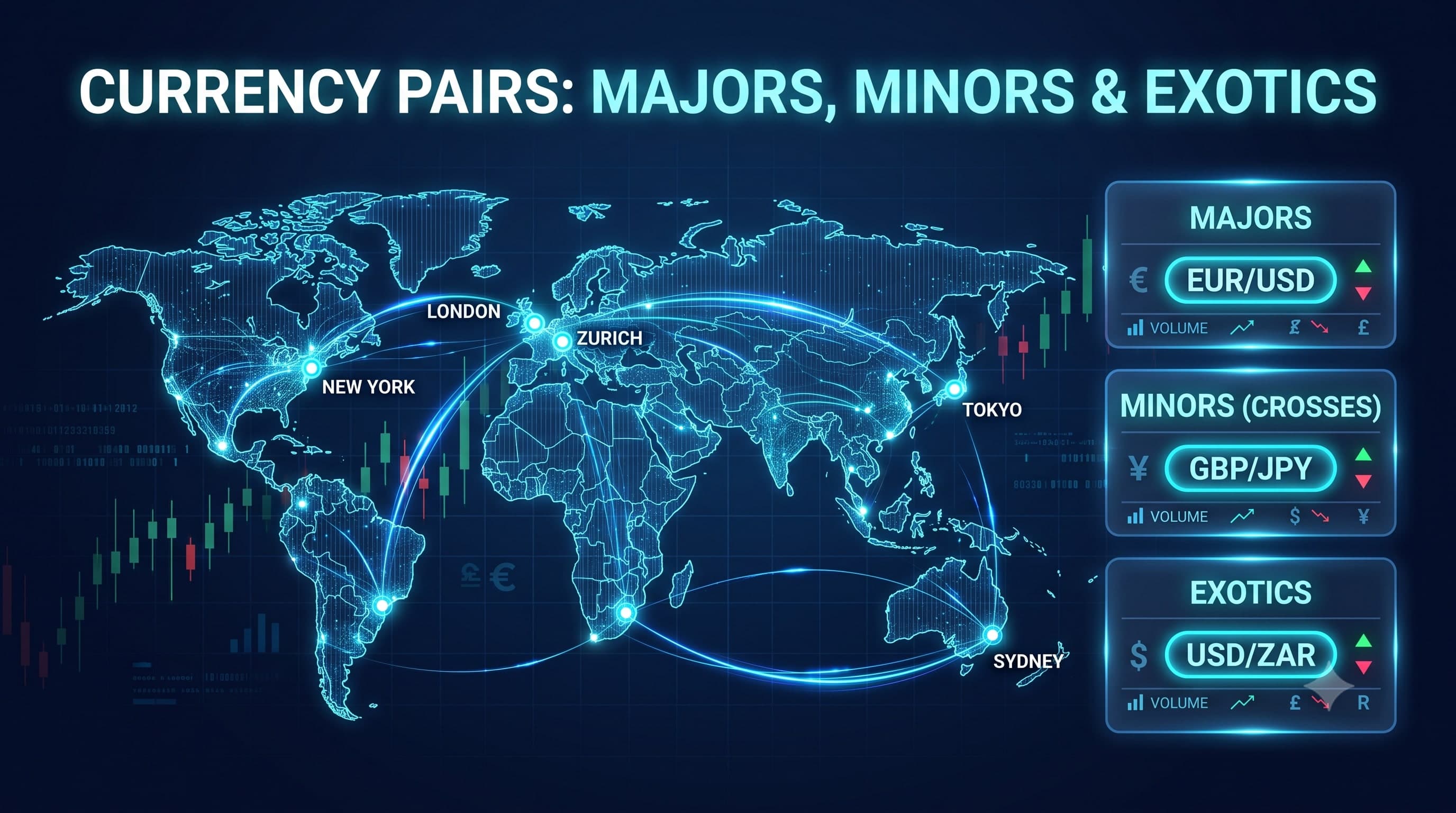
A currency pair quotes the value of one currency against another like EUR/USD showing how much of the second currency it takes to buy one unit of the first. Pairs fall into three groups: majors (the most traded), minors (major currencies without the US dollar), and exotics (a major paired with an emerging-market currency). Majors are usually the most liquid and beginner-friendly.
Key takeaways
Every trade involves a pair: you buy one currency and sell the other.
The first currency is the base; the second is the quote.
Majors are most liquid; exotics are least liquid and most volatile.
Beginners usually start with major pairs for tighter spreads and cleaner moves.
How do currency pairs work?
A pair shows the exchange rate between two currencies. In EUR/USD = 1.1000, the euro is the base currency and the US dollar is the quote currency. The number means one euro is worth 1.10 US dollars. When you buy the pair, you expect the base (euro) to strengthen against the quote (dollar); when you sell, you expect the opposite.
Every forex trade is really a bet on one currency relative to another never a currency on its own.
What are major currency pairs?
Majors are the most heavily traded pairs, all involving the US dollar. They include EUR/USD, GBP/USD, USD/JPY, USD/CHF, USD/CAD, and AUD/USD. Because they’re so widely traded, they offer the highest liquidity, the tightest spreads, and generally the cleanest price action which is why most traders, especially beginners, focus here.
What are minor currency pairs?
Minors (or crosses) pair major currencies with each other, without the US dollar. Examples include EUR/GBP, EUR/JPY, and GBP/JPY. They’re still fairly liquid but usually have slightly wider spreads than majors, and some like GBP/JPY can be notably volatile.
What are exotic currency pairs?
Exotics pair a major currency with an emerging-market or smaller-economy currency. Examples include USD/TRY (Turkish lira) or USD/ZAR (South African rand). They tend to be far less liquid, with much wider spreads and sharper, less predictable moves. They can offer opportunity, but they carry higher cost and risk generally not where beginners should start.
Which currency pairs should beginners trade?
Beginners usually do best focusing on one or two major pairs. EUR/USD is a popular starting point: it’s the most liquid pair in the world, has tight spreads, and moves in a relatively orderly way. Learning one pair deeply beats scattering your attention across many. If you also look at gold versus currencies, we compare them in Gold vs Currency Pairs.
How FXfolder helps you learn the market
FXfolder is an educational community platform, not a signal seller, covering currencies, commodities, and crypto for educational purposes:
Educational analysis across major pairs and beyond.
Transparent trade history so you can study real setups.
A free Telegram community to learn alongside other traders.
Frequently asked questions
What is the most traded currency pair?
EUR/USD is the most traded pair in the world. Its high liquidity gives it tight spreads and relatively smooth price action, making it popular with beginners and professionals alike.
What is the base and quote currency?
The base currency is the first one in the pair; the quote is the second. The price shows how much of the quote currency is needed to buy one unit of the base.
Are exotic pairs good for beginners?
Generally no. Exotics have wide spreads, low liquidity, and sharp, unpredictable moves. Beginners usually do better with liquid major pairs first.
How many currency pairs should I trade?
Fewer is better when starting out. Focusing on one or two major pairs lets you learn how they move, rather than spreading your attention too thin.
The bottom line
Forex currency pairs come in three types majors, minors, and exotics and every trade is a bet on one currency against another. Majors offer the liquidity, tight spreads, and cleaner moves that suit beginners best. Start with one major pair, learn it well, and expand from there.
Learn the market with a community: Join FXfolder’s free Telegram channel for educational, transparent trade ideas.
Risk disclaimer: Forex trading involves substantial risk of loss and is not suitable for every investor. All content on FXfolder is for educational purposes only and does not constitute financial, investment, or trading advice. Past performance is not indicative of future results. Always do your own research and consider your risk tolerance before trading.
Educational content only. Not investment advice.